The usual story about small-business digitalisation is that SMEs need to "go digital".
That description is becoming less useful.
Many Italian businesses are already digital. They use cloud services, online banking, electronic invoicing, collaboration tools, vertical SaaS, ecommerce, booking platforms and messaging every day.
The more interesting question is no longer whether they use digital tools.
It is whether those tools fit the way the business actually works.
Recent European data makes that distinction increasingly important.
Italy is not starting from zero
The European Commission's 2026 Digital Decade country report for Italy says Italy has made notable progress in SME digitalisation and in the uptake of cloud, AI and data analytics.
Eurostat's Digitalisation in Europe 2026 reports that 71% of EU SMEs reached at least a basic level of digital intensity in 2025.
Cloud adoption is particularly striking. Eurostat data for 2025 shows Italy among the EU leaders in paid cloud computing: about 75.6% of Italian enterprises used paid cloud services.
This is not a market waiting to discover the internet.
It is a market where many businesses already have a stack of digital tools.
And that changes the nature of the opportunity.
Digital adoption does not mean process fit
A company can use five different digital tools and still operate an important process manually.
That happens because software adoption is usually organised by category:
- accounting;
- CRM;
- booking;
- project management;
- ecommerce;
- payments;
- messaging;
- file sharing.
Business processes are not organised that neatly.
A real process may cross several categories at once.
A customer request arrives by email. The job is qualified in a spreadsheet. Availability is checked in a calendar. A quote is created in another system. Approval happens by WhatsApp. Status is tracked manually. At the end, someone re-enters the data into accounting.
Every individual tool may be digital.
The process between them is still manual.
The numbers show a second gap
Eurostat's 2025 data on e-business applications makes the pattern visible.
Across the EU, 41% of small enterprises used ERP software, 25% used CRM and only 11% used business-intelligence applications. Usage among large enterprises was dramatically higher: 89% for ERP, 65% for CRM and 69% for BI.
Those figures do not prove that every small company needs enterprise software. In fact, that would be the wrong conclusion.
They show something more useful: smaller companies are less likely to have specialised systems covering their operating processes end to end.
At the same time, many are digitally mature enough to use cloud applications comfortably.
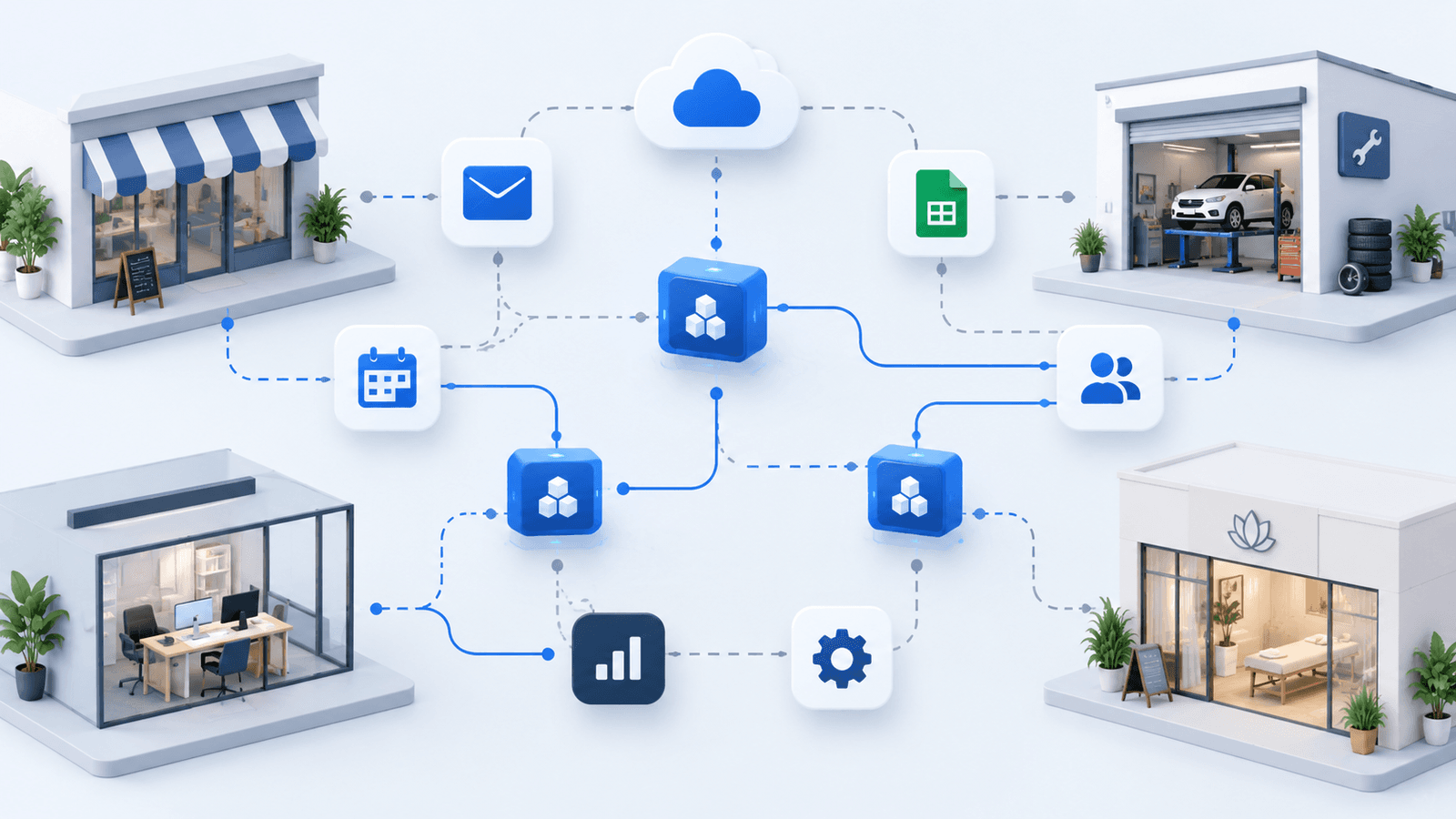
That combination creates what we call a software fit gap.
The business is digital enough to know exactly where the friction is, but the problem is too specific to be solved cleanly by another generic tool.
Why SaaS often stops at 80%
SaaS works because the same product can serve many customers.
That requires standardisation.
The product has to model the common version of a process: the booking flow that most companies use, the approval flow that most teams recognise, the CRM structure that works for a broad market.
That is a strength, not a weakness.
But a business often gets its differentiation from the part that is not standard.
A service company may allocate work using a specific mix of geography, technician skill and customer priority.
A distributor may approve an order using credit status, stock availability and commercial exceptions.
A facility may sell bookings, but capacity depends on physical resources that do not map cleanly to "one customer, one slot".
A generic platform can often cover 80% of the need.
The remaining 20% becomes workarounds.
The hidden software layer: spreadsheets, messages and people
This final 20% is easy to underestimate because it does not appear on an IT architecture diagram.
It lives in:
- spreadsheets with colours and formulas only one person understands;
- WhatsApp groups used as workflow engines;
- email threads acting as approval systems;
- copy-and-paste between SaaS products;
- daily checks performed from memory;
- shared documents that have quietly become databases.
These tools are not inherently bad.
A spreadsheet is often the fastest way to discover how a process should work. WhatsApp is extremely effective for communication. Email remains universal.
The problem appears when temporary coordination becomes permanent operating infrastructure.
At that point, the business is paying for the missing software through labour, errors, delays and dependency on individual knowledge.
This is not an argument for more software everywhere
There is an obvious counterargument: small businesses already have too much software.
We agree.
The solution to software fragmentation is not automatically another platform.
A custom application only makes sense when the process is frequent enough, specific enough and valuable enough to justify removing the manual layer.
Sometimes the correct answer is to configure an existing SaaS better.
Sometimes it is to automate two existing tools.
Sometimes it is to change the process.
And sometimes the right answer is a small, purpose-built application that sits between the systems already in place.
The point is not "build instead of buy".
The point is to recognise when the cost of forcing a process into generic software is higher than the cost of building the missing piece.
A new category between SaaS and traditional custom development
Traditional custom software has historically been difficult to justify for smaller process problems.
If solving a narrow workflow means a six-month project, a large discovery phase and an enterprise budget, the spreadsheet usually wins.
But the economics of software development are changing.
Reusable cloud infrastructure, mature frameworks, APIs and AI-assisted development all reduce the amount of undifferentiated work required to build a focused web application.
That does not make complex software simple.
It does make small, well-bounded software more economically viable than it used to be.
This is the space MicroFit is designed for:
Too specific for SaaS. Too small for traditional custom software.
The interesting digitalisation opportunity in Italian SMEs may not be replacing all their software.
It may be finding the small operational gaps between the tools they already use — and closing the ones that matter.