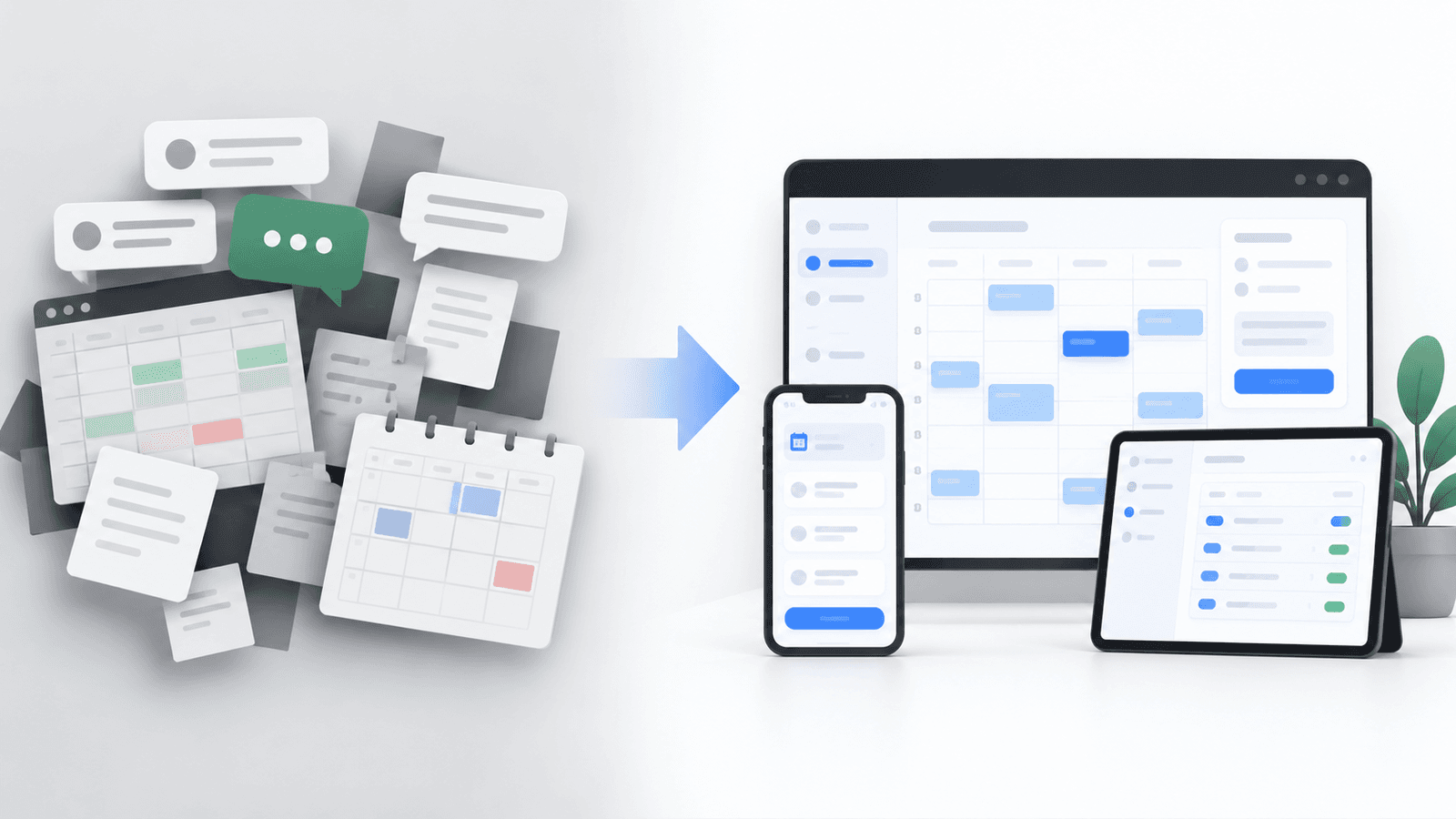
A booking process can work surprisingly well for a long time with tools you already have.
A customer sends a WhatsApp message. Someone checks a spreadsheet or shared calendar. A slot is confirmed. A reminder is sent manually. If a customer cancels, somebody moves things around.
For ten bookings a week, that may be perfectly reasonable.
At fifty, one hundred or several hundred bookings, the same process starts to behave like software — except people are doing the work the software should be doing.
That is usually the point where businesses start looking for a booking platform. And that is also where a second problem appears: the business does not quite work like the booking platform expects.
The warning signs
The issue is rarely "we need online booking" in the abstract. The real friction is usually hidden in the rules around the booking.
For example:
- capacity changes by day, location or resource;
- some services take longer than others;
- particular customers have priority or prepaid access;
- staff must approve some bookings but not others;
- availability depends on equipment, bays, rooms, vehicles or technicians;
- cancellations have different rules depending on timing;
- customers should receive reminders through the channel they actually use;
- management needs a simple view of utilisation, no-shows or remaining capacity.
A generic calendar can store a date and a time. A generic booking SaaS can cover many common workflows. But once the business starts compensating with notes, colour codes, extra spreadsheets and WhatsApp messages, the operating process has already escaped the software.
The wrong response is often a bigger system
When a lightweight process becomes difficult to manage, companies are often pushed toward one of two extremes.
The first is to keep adding manual work around the existing tools.
The second is to buy a much larger management platform and adapt the business to it.
Both can be expensive in different ways.
Manual work creates interruptions, duplicate entry and dependence on the people who know how the process really works. A large platform can introduce licences, implementation effort, training and features that have nothing to do with the original problem.
There is a third option: build only the missing layer.
What a right-sized booking app can look like
A small custom booking application does not need to become the company's new ERP.
Its job can be much narrower.
Imagine a garage, workshop, sports facility, clinic or service business with limited capacity. A focused application might include:
- Customer access — a simple login, secure link or customer code.
- Availability — only valid slots are shown, based on the actual capacity rules.
- Booking and cancellation — customers can act without calling or messaging staff.
- Operational rules — duration, capacity, eligibility or resource constraints are applied automatically.
- Reminders — confirmations and reminders are triggered consistently.
- Admin view — staff can see and adjust the schedule without maintaining a parallel spreadsheet.
- Basic reporting — utilisation, booking volume, cancellations or no-shows.
That can be enough.
The important design decision is not how many features can be added. It is which features remove the recurring work around the process.
What should stay out
Small software remains small when the boundary is explicit.
A booking MicroFit would not automatically need:
- a full CRM;
- accounting;
- payroll;
- inventory management;
- a native iOS and Android app;
- a complex customer portal;
- advanced analytics;
- every possible exception from day one.
Some of those capabilities may already exist elsewhere. Others may simply not be important enough to justify the extra complexity.
The application should connect to the tools that matter, not replace everything around it.
The real value is not "having an app"
The business case is usually operational.
If three people each spend twenty minutes per day checking availability, answering routine booking messages, correcting conflicts and updating a spreadsheet, that is roughly one hour of repeated administrative work every working day.
But time saved is only one part of the value.
A better process also reduces:
- missed or double bookings;
- delays in answering customers;
- inconsistent application of business rules;
- dependency on one employee's knowledge;
- manual reconciliation between different tools;
- uncertainty about real capacity.
In many small businesses, the most useful software is not software that transforms the entire company. It is software that removes one persistent source of friction.
When this is a good MicroFit
A booking workflow is a strong candidate when the problem is specific, bounded and repeated.
A useful test is:
Can we describe the process, the people involved, the rules and the systems it needs to talk to without redesigning the whole business?
If the answer is yes, the problem may be small enough for a focused application.
If every department, every system and every customer journey needs to change at the same time, it is probably no longer a MicroFit.
That distinction matters. The objective is not custom software for its own sake. It is the smallest useful piece of software that fits the way the business actually works.